
It’s not a genocide
It may become one, but calling Israel’s actions a genocide, absent due process, is mob mentality.

The word “genocide” was deployed to describe Israel’s retaliation as early as Oct. 9, 2023, two days after the Hamas-led killing of 1,200 people inside Israel launched this war.
There was no genocide then. There still is no genocide. Yet.
It nonetheless has, absent evidence and a legal determination, become a catechism on the left: Armies of the faithful chase politicians like ambulant “Jesus is God!” billboards, shouting out doctrine. Belief systems are contagious, and the Church of Genocide is gaining converts on the right.
Graham Platner, the Democratic nominee for the Maine Senate seat whose campaign imploded last week, was a true believer, clinging to the true faith until the end.
Yet, inappositely, a blip of commentary about the sexual assault allegations that felled Platner (and which he denies) makes clear why the use of “genocide” charge is irresponsible.
“I know I’m old-fashioned this way, but I still think due process is the best way (ie: the only reliable way) to determine guilt and the truth of accusations,” Glenn Greenwald, a lawyer and reporter, said on Twitter. “Online mobs and trial by media are infinitely more unreliable for all sorts of reasons that should be obvious.”
This stood out, because Greenwald obsessively accuses Israel of genocide, absent due process, without qualification.
Greenwald is not alone: True believers have proliferated. Pronouncing a crime without the caveats that would normatively attach to one that has yet to be adjudicated is a function of blind faith, not of due process. Shaming others into doing so is not protest, it is weaponized evangelism, with all its sweep and terror.
A faith system predicated on discarding analytical and legal norms has swept up those who otherwise are the keenest to hold up those norms. And its apotheosis is the delusional investment in the disappearance of Israel, an outcome insinuating into the mainstream of political discourse, even as expressions of the glories Israel’s erasure would reap seem to leap out of the Book of Revelations.
The Gaza War has been prolonged and ugly. Its horrors demand reckonings for leaders on all sides, including Israel’s, just as the Ukraine war invites reckonings, just as the depredations in U.S. occup[ied Iraq deserved reckonings. But it is a standard issue 21st century war.
Determining Israel’s actions are a genocide, absent due process, is the mentality of the mob.
Each believer is not necessarily a bad person: They see real horrors. Tens of thousands of Palestinian lives have been snuffed out. Tens of thousands of children will never become men and women. Millions of people are displaced. Whole cities have become rubble.
Hamas alone is not responsible for the carnage. There are plausible allegations of Israeli war crimes. There are statements and actions by Israeli officials and public officials that echo events and rhetoric that has presaged genocides. This is typical of societies seized with wartime hatreds. Often, they recover before devolving into the ultimate crime; sometimes they do not.
The good men and women who see these horrors and become consumed with a thirst for answers in some cases coalesce into mobs who destroy worlds, like anticommunists in the 1950s, like the Americans now who are rattled by violent crime and who unleash their fury on migrants.
The Church of Genocide is ready to exact similar retributions on Israel and its adjacents: impure Jews, politicians who resist their imprecations, anyone in their way.
1. “Alleged.”
One of the first things a reporter learns is not to describe a killing that has yet to be adjudicated a “murder,” however horrific the circumstance.
Genocide, like murder, is an adjudicated crime. Germanely, it is one Israel has been charged with in the International Court of Justice, which has yet to deliver its verdict.
The standard exists because of the presumption of innocence that is one of the pillars of free societies. The unqualified use of “murder” or “genocide” or any crime by a person in a position of authority – a reporter, a lawyer, an elected official – prejudices the case.
If a suspect has indeed been charged with murder, “alleged” attaches to the charge in every case, until there is a verdict.
Wikipedia uses “genocide” without qualification in this entry on allegations against Israel. Contrast this with the online reference work’s careful (and correct) use of “allegations” of genocide to describe Hamas’ actions on Oct. 7. Norms have become mutable in an era where political agendas rule
Ideally, the same standards of presumption of innocence should prevail in everyday conversation and even in advocacy.
They do not, and the reasons in certain instances are understandable. People who lost loved ones in Gaza will use “genocide” unadorned in the way a victim’s family will stand outside a courthouse bearing a placard that says “Murder is murder” even while the trial is underway.
Reasonable societies accommodate the anomalies of grief, an inherently unreasonable state. The presumption of innocence does not obviate outrage; it contains it. But containing outrage, keeping it from intoxicating the discourse, requires the guardians of social norms – reporters, lawyers and lawmakers among others — to uphold the presumption of innocence.
2. The Standard of Intent
A genocide conviction against Israel would set a precedent. The ICJ has never delivered a verdict of genocide, and no nation has been found guilty of the crime.
There have since the convention went into effect in 1951 been three cases of international tribunals finding groups – not nations – guilty of genocide, in Rwanda, Cambodia and the former Yugoslavia.
The reason is the crime’s daunting standard of intent. “In order to infer the existence of dolus specialis [special intent] from a pattern of conduct, it is necessary that this is the only inference that could reasonably be drawn from the acts in question,” according to the 2015 ruling in which the ICJ rejected Croatia’s charge of genocide against Serbia.
Accusers of genocide against a state must show a pattern of conduct and demonstrate that the sole intent of the pattern of conduct was genocide.
That could prove daunting for Israel’s accusers. In the Gaza war, they must establish an overarching pattern of genocidal intent in which a central theory of the war has been absent and in which multiple Israeli political and security factions have been in constant tension if not opposition with one another – including about humane treatment of the Palestinians. They must establish a pattern of intent by the party that was attacked and caught catastrophically off guard at 6:29 am Oct. 7, 2023.
“Israel did not commit genocide and is not committing genocide in Gaza,” Benny Morris, the Israeli historian who was among the first to identify Israel’s ethnic cleansing of the Palestinians in 1949, wrote last year on this platform. “There is no government policy, no plan, no intention, no activation of a plan to kill the Palestinian people. Genocide is a top-down affair, a national project, decided by a government or ruling party. Small massacres in wartime are routinely bottom-up affairs, with sergeants, lieutenants, captains ordering killings, as in Mai Lai in Vietnam. But genocides are organized, national projects.”
Another way to establish intent is to quote a war’s managers, which has proven difficult for Israel’s accusers without resorting to manipulations. South Africa, which initiated the genocide case at the ICJ, in its indictment cited Yoav Gallant, then the defense minister, telling troops, at the war’s outset: “Gaza won’t return to what it was before. We will eliminate everything. If it doesn’t take one day, it will take a week.”
In fact, Gallant said “There will be no Hamas” after “We will eliminate everything,” substantially narrowing his meaning to the terrorist group, and not to the entirety of Gaza. (The ICJ, in accepting South Africa’s case, restored the sentence.)
South Africa also misidentifies the source of Israeli Prime Minister Benjamin Netanyahu’s citation of “Remember what Amalek did to you.” The citation comes from Deuteronomy, and refers to Israel escaping the genocide its deadliest enemy launched against it while Israel fled Egypt. The phrase is understood among Israelis and Jews generally as an appeal to remember God even in the most dire circumstance; its use was commonplace during the Holocaust, which is why it appears on Holocaust memorials including at The Hague.
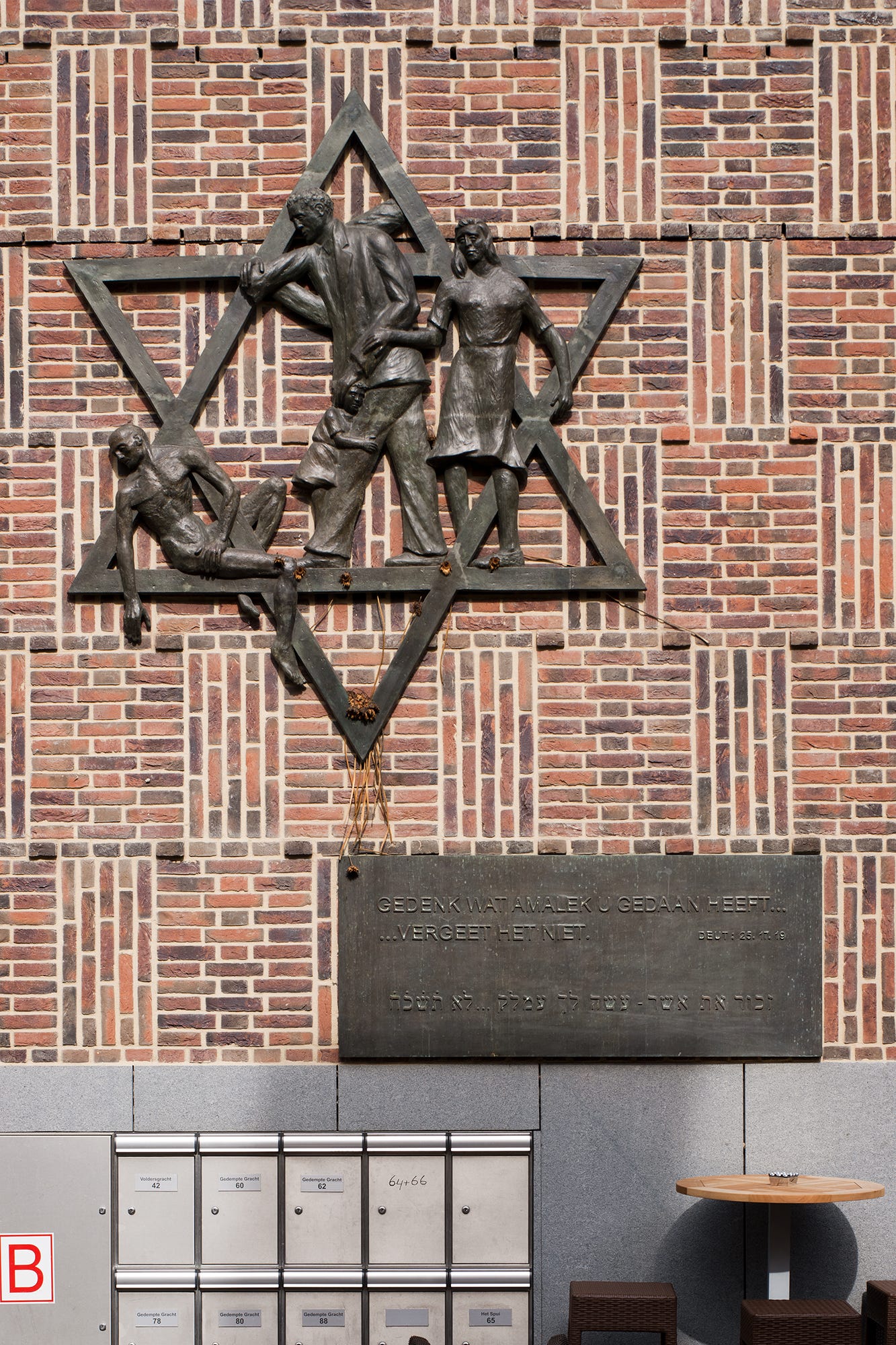
In the South African document, the phrase is misattributed to the Book of Samuel, which takes place hundreds of years later and refers to God’s command to King Saul to wipe out Amalek. South Africa gets not just the quote but the story wrong: Netanyahu “invoked the Biblical story of the total destruction of Amalek by the Israelites,” the charge says. King Saul disobeyed God and did not wipe out Amalek – and his disobedience is the point of the passage. The ICJ judges, perhaps better biblically versed than the South African prosecutors, did not cite any citation of Amalek.
Yair Rosenberg long ago did much of the work in picking apart these citations. I don’t know about Yair, but I must confess to a queasiness in getting this deep into biblical citations.
It is like arguing with a lunatic on his own terms. It is deeply disorienting.
But it’s necessary work, I realized when I read that The New York Times’ Ezra Klein said on his podcast: “Now you can debate which biblical passages Netanyahu is referring to. I find that debate a little bit strange.”
First there’s no debate: South Africa is plainly wrong.
But how language is understood, the culture it emerges from, is not even a little bit strange: It is critical to understanding intent. My God, it is critical to writing. Israelis hearing this particular phrase would not have understood it as a call to murder, but as an appeal to believe in divine protection: How is grasping that “strange”?
3. Only One Definition of Genocide Pertains
There are not multiple definitions of genocide. There is one very precise one, the legal definition in the 1951 convention:
“In the present Convention, genocide means any of the following acts committed with intent to destroy, in whole or in part, a national, ethnical, racial or religious group, as such:
Killing members of the group;
Causing serious bodily or mental harm to members of the group;
Deliberately inflicting on the group conditions of life calculated to bring about its physical destruction in whole or in part;
Imposing measures intended to prevent births within the group;
Forcibly transferring children of the group to another group.”
The absence of due process notwithstanding, there are a plethora of human rights groups, politicians, scholars of genocide and opiners that say Israel is committing genocide.
Then there are accusers who rattle off the names of these groups and scholars like a recitation of the saints on All Hallows Day, as if volume arrives necessarily at truth. In their recitations, they incant “Jewish” and “Israeli” descriptors as emphatics. (Would these same folks accept the weight of “Jewish” as a descriptor for anyone dismantling the genocide accusation?) Mehdi Hasan, the founder of the Zeteo media outlet, is a high priest of this particular catechism.
There are instances where due process does not obtain in naming a genocide: Defining the Ottoman era massacres of Armenians as a genocide as a political and moral question because there were no laws against genocide in 1915, no court to adjudicate them.
In our era, with a Genocide Convention and a court to adjudicate it in place, the tension between a political and a legal definition is untenable. Israel deserves the protections that we extended to O.J. Simpson. (I can’t believe I typed that sentence, but here we are.)
There are efforts to expand the definition of the crime. Ezra Klein in his New York Times podcast interviews Philippe Sands, a lawyer who has argued genocide cases and who wants to loosen the legal definition of genocide precisely because it is so daunting.
Sands, who has written a book of the genesis of the term and of the crime, argues in the podcast that the high bar established in the convention of “intent” is not true to the person who coined the word, Raphael Lemkin, the Jewish lawyer who lost family in the Holocaust.
“Lemkin’s conception didn’t have what has emerged as a special intention that has to be proven,” he tells Klein. “Lemkin also had a much broader conception of which groups were covered. You’ll have noticed political groups are excluded.”
He believes Lemkin would have applied the term to Israel’s actions in Gaza. (Members of Lemkin’s family are separately taking legal issue with the Pennsylvania based Lemkin Institute for Genocide Prevention for arguing that Israel’s actions in Gaza are genocide. The Institute was founded in 2021 and named without consulting his family. Lemkin was a Zionist.)
Sands argues that raising the bar has devastating consequences.
“The International Court of Justice said [in Croatia v. Serbia in 2015]: No, it’s not [genocide],” Sands tells Klein. “It left the consequence that, yes, it’s crimes against humanity and war crimes. And the consequence has been devastating within Croatia and within the region. Why did the Bosnians get a genocide for Srebrenica, and we only got a crime against humanity for Vukovar?”
His argument is gaining international traction: Ireland has called on the ICJ to expand the definition of genocide.
Liberals campaigning to blunt a law – to make it less precise – is unusual. Maximizing penalties is an argument one usually associates with the right. Imagine, for instance, a broad murder statute that would not allow for mitigating circumstances. What would happen to, say, the battered woman syndrome defense?
4. The misapplication of “genocide” is reckless.
The correct use of the word for the worst of all crimes would always be critical; it is especially critical in our era, when malign political actors say facts are fake.
Sands and others advocating for expansion of the law may succeed. Until they do – and if Israel’s actions meet the expanded definition – absenting “alleged” from accusations of genocide is at least as reckless as, say, Donald Trump’s unqualified assertions that elections he does not favor are “rigged.”
It is reckless to attach oneself, however unintentionally, to a movement that seeks to divest Jews from history, to deny the consequences of the Holocaust by suggesting that everyone, including Jews, commits Holocausts. It is reckless in a year in which J.D. Vance removed Jews from the Holocaust.
It is reckless precisely because there are circumstances in Israel that obtain before a genocide, which does not necessarily require the magnitude of the Holocaust to earn the definition: Leaders announcing food blockades and hindering aid distribution. Documented allegations of torture. Polls showing substantial majorities of Israelis favoring the removal of Palestinians from Gaza.
One of the flaws of the South African indictment is that it quotes officials who are like Stalin’s pope: Big talkers who command zero divisions. One of these is Amichai Eliahu whose imprecations are so reckless – and, indeed, genocidal – that Netanyahu suspended him from the government for a time.
It would be easy to dismiss Eliahu, who is heritage minister, because he commands no divisions; but he is in charge of educating the public. And he still has that job, employed by a government that otherwise has done little to discourage the rhetoric
These depredations are the roiling consequences of war – and they are evident as much among Palestinians as they are Israelis.
Dehumanizing rhetoric, killing without meaningful consequence, depraved indifference – these factors preceded genocides, as in Rwanda and the former Yugoslavia. But anyone who has spent time in a country deep in the throes of war will tell you they are commonplace and more often then not, do not culminate in genocide – because good people intervene not to further dehumanize one side, but to gently nudge the sides to recognize the horrors that could portend.
I have seen these conditions in every war zone I covered – not just in Israel and among Palestinians, but in Afghanistan, in Bosnia after the war, in Congo, in Northern Ireland. No genocides ensued.
Dampening hatred, nurturing coexistence is hard, grueling work – which is why pronouncing “genocide” before one has taken place is a flamboyant sleight of hand, a means of pretending to witness while looking away.
Shouting “genocide” is giving in to belief and giving up on reality, it is chanting curses into the wind, and at the worst possible time: when we need to be present, to end this war, to end this carnage, to guide Israelis and Palestinians toward conciliation.
I was born the same year as Israel and grew up in a Zionist home and school. I spend a good part of my day reposting news of the deaths of Palestinian babies and families, and footage of every settler attack because I feel called to come as close as I can to bearing witness. One can parse words forever, but I personally, cannot unsee what I have been seeing. It’s not important to me whether these heinous, state-enabled acts technically qualify as a genocide or not, when thousands continue to be butchered and stripped of every human dignity. Nothing good will come of this for the people of Israel. There will be no safety. And globally, Jews are in the greatest danger they have been since 1945. I don’t see the point of this piece when the cruelty and brutality is endless and there is no accountability. But hey, that’s just me.
For decades, there has been little to no due process for atrocity after atrocity.